

We enter the universe of illustrator and designer Pablo Benito to learn more about his dreamlike, full-color spaces
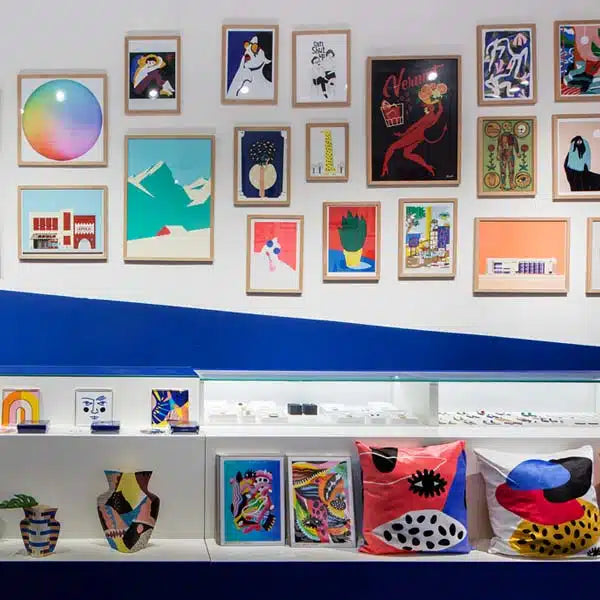
I'm sure many of us enjoy imagining spaces and would love to step inside iconic buildings, like the ones that fill social media or those reinterpreted by PeBe. Illustrator and designer Pablo Benito is the creator of the ' Real Clubs ' project, and this version of... Razzmatazz at night The piece he released at the height of the pandemic really resonated with us. We chatted with one of the artists from the OMG BCN family, a creator who champions architecture as a journey.

PeBe in disguise.
Who is PeBe?
When I started university, I wanted to be a DJ—my brother had been DJing for a long time and was a big influence on me musically—then I had a love-hate relationship with graphic design, and finally I found my niche in illustration. Many of my jobs are commissions, but I have creative freedom on my own projects, and DJing is my true calling. It worries me to think I'll always be the same… after so much time stuck in the city, I've also fantasized about being country girl , although I am very much a city person.
Architecture is one of the hallmarks of your work. Initially, your pieces were inanimate and flat, but you've gradually introduced more spatial nuances, more life. Where did this interest come from, and how has it evolved?
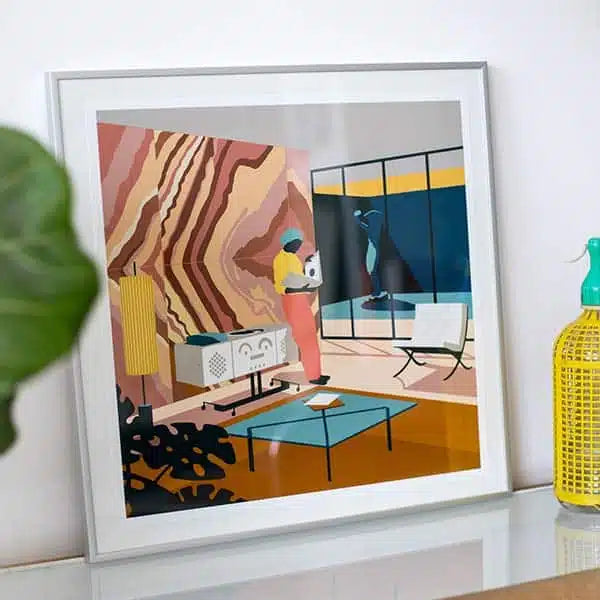
I've always been drawn to spaces, almost from an anthropological and social perspective rather than an aesthetic one. I'm interested in the materials used to construct an interior, what you feel when you're in a space, on a perceptual level. What surprised me about clubs was how they change, and how you change, depending on the light, whether it's a tiny room, whether it has a terrace… that led me to photograph club facades. Then I wanted to capture the work of architects I admired, each time with more details like shadows, vanishing points, and light. Now my obsession is with invented spaces [the collection] Horizonts ] and I feel more capable of introducing nature and living beings. During the lockdown I also started to imagine how I would interact with some houses: drawing spaces helps you travel, it's as if you were there, even without leaving your living room.

Project Insomnia and Stay at Mies.
Another striking aspect of your work is the color.
Yes, color is perhaps the aspect that best represents me, along with light, shadows, and composition. But it's precisely with color that I always have many doubts. You change the color, and the moment in the illustration changes: from morning to nightfall, or depending on the light, it can be winter, summer, or spring. I approach all my projects from four perspectives. I'd like to explore darker themes, to continue down the path I started with the Insomnia project.
Returning to your buildings, do you have any architectural preferences?
In each project I have sought to learn something new. The first projects were the club facades And what I knew of Barcelona caught my attention Modernism , although I didn't want to link or associate myself with the 'tourist' object. I've also photographed American Case Study Houses. With the series I was commissioned to do on London, I came across constructivism, brutalism, Soviet rationalism, and the Art Deco . I recently took a trip to Armenia and was blown away by the Soviet monuments. Latest: I've started exploring the Land art , halfway between functional architecture made with materials like mud and wood, and abstract compositions. We think everything we do is new, but we can easily find it in references from 2,000 years ago.
Can you tell us about any new projects?
I have a project underway about the cities of the future, a project for an English supermarket that uses super-intelligent robots and promotes smart shopping. I've taken it a step further technically, bringing the robots to life. Other recent works include a poster for Casa Seat and the album cover for Joan Bibiloni. As for my personal projects, I'm about to release a new piece in the ' Real Clubs ' series, the Manchester Haçienda. I leave series unfinished: I want the projects to be... Horizons and Houses evolve with me.

Horizons VIII and Eve.
You work digitally, but you're also drawn to the manual. Tell us about your creative process.
I'm passionate about the concept, and the unseen aspects are very important. With the poster for Casa Seat, for example, I went back to the Gràcia neighborhood, observing the monuments, the fountains… As for the drawing itself, I'm impatient; I do something quickly, but then I start all over again. And sometimes I find it hard to separate myself from the designer's eye. What I want to do now is discover new techniques, like screen printing on posters, work with textures, get closer to the manual process, and learn. There are areas where digital technology can't reach.
You tell us that you turn to books as a source of inspiration.
Yes, I have many architecture books, and knowledge of different spaces and techniques helps me develop my own world. I recommend 'Habiter la terre' by Jean Dethier (Flammarion) and 'Building and Living: Ethics for the City' by Richard Sennett (Anagrama), about how the cities of Paris, New York, and Barcelona were reimagined at the end of the 19th century—a topic that has become relevant again in light of Covid, pollution, and tourism. I also own and consult books on club culture, such as 'Mute: A Visual Document: from 1978-tomorrow'.
In such a visual and image-saturated world, what do you surround yourself with at home?
I have illustrations at home, but I get tired of them just like I get tired of my own work; besides, I've moved many times and I've learned to detach myself from objects, although my stereo and vinyl records are always with me. Also, the Vinçon plush cat I was given as a child; it's missing its eyes and ears, but I'd die without it. I'm still somewhat following the principle of... Art Deco , something that Tamara de Lempicka also championed: breaking with the past and making your space however you want.